During the month of February, 2021 while in prayer, I heard the Lord speak to my spirit. He said, “I will watch over My Word to perform it.” I recognized that this was a Scripture and began searching for it in my Bible.
And the word of the Lord came to me, saying, “Jeremiah, what do you see? And I said, “I see an almond branch.” Then the Lord said to me, “You have seen well, for I am watching over my word to perform it.”
Jeremiah 1:11-12
There was no doubt in my mind that the Lord was speaking. I decided to look up the farming process of an almond tree.
November through January, almond trees go through a period of dormancy, losing their leaves and chilling out in California’s cool, wet winters. Orchard soils store up rainwater for the upcoming growing season, and the trees store nutrients and energy for next year’s crop. Toward the end of dormancy, buds begin swelling on each tree’s branches in preparation for bloom
Between mid-February and mid-March, almond tree buds burst into beautiful white and light-pink blooms.
From March to June, almond kernels mature and grow to full size, with the shell hardening around it—both protected by a fuzzy outer hull.
In July, almond hulls split open, exposing the almond shell and allowing it and the kernel inside to dry.
From August through October, mechanical tree “shakers” harvest the crop by vigorously shaking it to the ground.
What I found even more fascinating is that during the time that the Lord was speaking to me about this verse, my youngest daughter became pregnant! I began to reflect. She and her husband began trying in November and conceived in January. Their due date will be the end of September. It is as though the Lord was giving me an event in the natural to coincide with His Word!
I am not sure what this all means, and whether or not Jeremiah 1:11-12 is speaking of a literal timeline. What I do know is that God says He will watch over His Word to perform it!
My thoughts are nothing like your thoughts,” says the LORD. “And my ways are far beyond anything you could imagine. For just as the heavens are higher than the earth, so my ways are higher than your waysand my thoughts higher than your thoughts.
Isaiah 55:8-9
What I do know is that our God is omniscient, omnipotent and omnipresent. There is no one like Him and there never will be. He is Alpha and Omega. He is the Creator of the heavens and the earth and all things in it. A worm is more complex than a smart phone and yet we would never admit that a cell phone evolved from nothing.
In the beginning God spoke and all things became. Genesis chapter 1 clearly delineates the order in which He spoke and the order in which what He spoke was established.
His Word is powerful and it produces! It will NEVER return void!
“The rain and snow come down from the heavens and stay on the ground to water the earth. They cause the grain to grow, producing seed for the farmer and bread for the hungry. It is the same with my word. I send it out, and it always produces fruit. It will accomplish all I want it to, and it will prosper everywhere I send it.
Isaiah 55:10-11
For the word of God is alive and powerful. It is sharper than the sharpest two-edged sword, cutting between soul and spirit, between joint and marrow. It exposes our innermost thoughts and desires.
Hebrews 4:12
Has the Lord spoken a word to you? Are there promises you are holding onto? Are you delighting in Him?
Numbers 23:19 says that He is not a human that He should lie, or change His mind. It poses the questions, “Does He speak and then not act, promise and not fulfill? He is faithful even when we are not.
In this season, I felt the Lord returning me to the Prayer of Jabez. It is a brief but powerful prayer found in 1 Chronicles 4:9-10. It reads as follows:
9 “Jabez was more honorable than his brothers. His mother had named him Jabez, saying, ‘I gave birth to him in pain.’ 10 Jabez cried out to the God of Israel, ‘Oh, that you would bless me and enlarge my territory! Let your hand be with me, and keep me from harm so that I will be free from pain.’ And God granted his request.”
This historical context of the Prayer of Jabez can be found within a genealogical record in 1 Chronicles, which primarily focuses on the lineage of the tribes of Israel.
Jabez is mentioned briefly, yet his prayer stands out amidst a long list of names, suggesting that his life and request were noteworthy.
The name Jabez means “sorrow” or “pain,” perhaps reflecting the circumstances of his birth. His mother may have named him this due to the pain she experienced during childbirth. His name may have carried a stigma or burden throughout his life.
Literally, it could read, “He causes (or will cause) pain.” Something about Jabez’s birth was unusual—so much so that his mother memorialized it in his name.
The greatest burden of Jabez’s name was how it defined his future. In biblical times, a man and his name were intimately related. A name was often taken as a wish for or prophecy about the child’s future. For example, Jacob can mean “grabber,” reflecting his scheming character. Naomi and her husband named their two sons Mahlon and Chilion, meaning “puny” and “pining.” That was exactly what they were—both died in early adulthood. Solomon means “peace,” and he became the first king of Israel to reign without going to war.
God Himself has many names that describe different aspects of His many-faceted character. From Got Questions, here are some of the better-known names of God in the Bible:
EL, ELOAH [el, el-oh-ah]: God “mighty, strong, prominent” (Nehemiah 9:17; Psalm 139:19) – etymologically, El appears to mean “power” and “might” (Genesis 31:29). El is associated with other qualities, such as integrity (Numbers 23:19), jealousy (Deuteronomy 5:9), and compassion (Nehemiah 9:31), but the root idea of “might” remains.
ELOHIM [el-oh-heem]: God “Creator, Mighty and Strong” (Genesis 17:7; Jeremiah 31:33) – the plural form of Eloah. Being plural, Elohim accommodates the doctrine of the Trinity. From the Bible’s first sentence, the superlative nature of God’s power is evident as God (Elohim) speaks the world into existence (Genesis 1:1).
EL SHADDAI [el-shah-dahy]: “God Almighty,” “The Mighty One of Jacob” (Genesis 17:1; Exodus 6:3; Ruth 1:20) – speaks to God’s ultimate power over all.
ADONAI [ˌædɒˈnaɪ; ah-daw-nahy]: “Lord” or “Master” (Genesis 15:2; Judges 6:15) — emphasizes God’s authoritative relationship with humanity and our need to submit in reverence to God. Adonai was often used in place of YHWH, which was thought by the Jews to be too sacred to be uttered by sinful men.
YHWH / YAHWEH / JEHOVAH [yah-way / ji-hoh-veh]: “LORD” (Exodus 3:15; Deuteronomy 6:4; Daniel 9:14) – strictly speaking, the only proper name for God. Translated in English Bibles “LORD” (all capitals) to distinguish it from Adonai, “Lord.” The revelation of the name is given to Moses “I AM WHO I AM” (Exodus 3:14). This name specifies an immediacy, a presence. Yahweh is present, accessible, near to those who call on Him for deliverance (Psalm 107:13), forgiveness (Psalm 25:11) and guidance (Psalm 31:13).
YAHWEH-JIREH [yah-way-ji-reh]: “The Lord Will Provide” (Genesis 22:14) – the name memorialized by Abraham when God provided the ram to be sacrificed in place of Isaac.
YAHWEH-RAPHA [yah-way-raw-faw]: “The Lord Who Heals” (Exodus 15:26) – “I am the Lord who heals you” both in body and soul. In body, by preserving from and curing diseases, and in soul, by pardoning iniquities.
YAHWEH-NISSI [yah-way-nee-see]: “The Lord Our Banner” (Exodus 17:15), where banner is understood to be a rallying place. This name commemorates the desert victory over the Amalekites in Exodus 17.
YAHWEH-M’KADDESH [yah-way-meh-kad-esh]: “The Lord Who Sanctifies, Makes Holy” (Leviticus 20:8; Ezekiel 37:28) – God makes it clear that He alone, not the law, can cleanse His people and make them holy.
YAHWEH-SHALOM [yah-way-shah-lohm]: “The Lord Our Peace” (Judges 6:24) – the name given by Gideon to the altar he built after the Angel of the Lord assured him he would not die as he thought he would after seeing Him.
YAHWEH-ELOHIM [yah-way-el-oh-him]: “LORD God” (Genesis 2:4; Psalm 59:5) – a combination of God’s unique name YHWH and the generic word for “God” signifying that He is the Lord who is God.
YAHWEH-TSIDKENU [yah-way-tzid-kay-noo]: “The Lord Our Righteousness” (Jeremiah 33:16) – As with YHWH-M’Kaddesh, it is God alone who provides righteousness (from the Hebrew word tsidkenu) to man, ultimately in the person of His Son, Jesus Christ, who became sin for us “that in him we might become the righteousness of God” (2 Corinthians 5:21).
YAHWEH-ROHI [yah-way-roh-hee]: “The Lord Our Shepherd” (Psalm 23:1) – David knew what it was to be a shepherd to his sheep, and he declared, “The Lord is my shepherd [Yahweh-Rohi]; I shall not want” (Psalm 23:1, ESV).
YAHWEH-SHAMMAH [yah-way-sham-mahw]: “The Lord Is There” (Ezekiel 48:35) – the name ascribed to Jerusalem and the temple there, indicating that the once-departed glory of the Lord (Ezekiel 8—11) had returned (Ezekiel 44:1–4).
YAHWEH-SABAOTH [yah-way-sah-bah-ohth]: “The Lord of Hosts” (Isaiah 1:24; Psalm 46:7) – Hosts means “hordes,” both of angels and of men. He is Lord of the host of heaven and of the inhabitants of the earth, of Jews and Gentiles, of rich and poor, master and slave. The name is expressive of the majesty, power, and authority of God and shows that He is able to accomplish what He determines to do.
EL ELYON [el-el-yohn]: “Most High” (Genesis 14:18–22; Deuteronomy 32:8; Psalm 7:17; 57:2; 97:9) – derived from the Hebrew root for “go up” or “ascend,” so the implication is of that which is the very highest. El Elyon denotes exaltation and speaks of absolute right to lordship.
EL ROI [el-roh-ee]: “God of Seeing” (Genesis 16:13) – the name ascribed to God by Hagar, alone and desperate in the wilderness after being driven out by Sarah (Genesis 16:1–14). When Hagar met the Angel of the Lord, she realized she had seen God Himself in a theophany. She also realized that El Roi saw her in her distress and testified that He is a God who lives and sees all.
EL-OLAM [el-oh-lahm]: “Everlasting God” (Psalm 90:1-3) – God’s nature is without beginning or end, free from all constraints of time, and He contains within Himself the very cause of time itself. “From everlasting to everlasting you are God” (Psalm 90:2).
EL-GIBHOR [el-ghee-bohr]: “Mighty God” (Isaiah 9:6) – the name describing the Messiah, Christ Jesus, in this prophetic portion of Isaiah. As a powerful and mighty warrior, the Messiah, the Mighty God, will accomplish the destruction of God’s enemies and rule with a rod of iron (Revelation 19:15).
I was named Barbara after my Lebanese grandmother.
According to Our Bible Heritage, Barbara is derived from the Greek word barbaros, meaning “foreign” or “strange.” In Hebrew, it is sometimes linked to “בַּרְבָּרָה,” reflecting the idea of being set apart or different. Webster’s Unabridged Dictionary defines Barbara as “a woman of foreign origin,” while some modern sources emphasize grace and elegance. Over centuries, the name has adapted to many cultures while retaining its sense of uniqueness and individuality.
Mmmmm, I resonate somewhat with this meaning. ☺️ Today, most of us don’t know the meanings of each other’s names—but in biblical times, names carried great weight. Imagine how people may have reacted to Jabez—a name meaning “pain” didn’t predict a promising future.
The prayer of Jabez in 1 Chronicles 4:10 contains an urgent request for four things:
1) God’s Blessing – “Oh, that You would bless me” Jabez recognizes that the God of Israel is the true source of every blessing, and he humbly petitions for God’s grace and favor. His request reflects a deep longing for divine approval and provision.
In the biblical sense, blessing extends far beyond material prosperity—it encompasses spiritual well-being, physical health, protection, and a flourishing life rooted in God’s presence. By asking for blessing, Jabez affirms God’s sovereignty and acknowledges that lasting success and fulfillment can only come from Him.
2) Expansion of Territory – “Enlarge my territory” Jabez prays for growth and success in all areas of his life, desiring that his days would be marked by increase.
This request may be understood both literally and metaphorically. Literally, it could mean an increase in land or possessions. Metaphorically, it expresses a yearning for greater influence, expanded opportunities, and new responsibilities entrusted by God. Jabez seeks not only personal advancement but also a larger capacity to serve, impact, and fulfill God’s purposes.
3) The Presence of God’s Hand – “Let Your hand be with me” In this plea, Jabez asks for the continual guidance, protection, and empowering strength of God in his everyday life.
By seeking God’s hand, he confesses his dependence on divine help for every victory, decision, and challenge. This is an expression of humility and trust—acknowledging that without God’s presence, his efforts would be in vain.
4) Protection from Harm – “Keep me from harm so that I will be free from pain” Echoing Jesus’ later teaching—“Deliver us from the evil one” (Matthew 6:13)—Jabez appeals to God as his ultimate protector.
His name carried a painful meaning, and this prayer reflects a longing to live free from the sorrow and hardship it symbolized. It is both a request for physical safety and a cry for emotional and spiritual healing. Jabez desires not only to be spared from harm but also to walk in a new identity—one shaped by God’s favor, purpose, and peace.
“And God granted his request.”
How wonderful and merciful is our God! His response to Jabez is one of affirmation. He heard and He answered.
Jeremiah 33:3 Call to me and I will answer you and tell you great and unsearchable things you do not know.’
No matter the labels placed upon us, the challenges we face, or the negative perceptions we may hold about ourselves, we have a transcending and transforming power in Jesus Christ. Our true identity is that we are sons and daughters of the Most High God, seated with Him in the heavenly places.
1 Peter 2:9 But ye are a chosen generation, a royal priesthood, an holy nation, a peculiar people; that ye should shew forth the praises of him who hath called you out of darkness into his marvellous light;
Join me in this season and pray…
‘Oh, that you would bless me and enlarge my territory! Let your hand be with me, and keep me from harm so that I will be free from pain.’ And God granted his request.” 1 Chronicles 4:10

I’ve been reading through Proverbs with the help of Today in the Word by Russell Meek and some commentaries.
Scriptures like: Psalm 53:1 Only fools say in their hearts, “There is no God.” They are corrupt, and their actions are evil; not one of them does good!
The word “fool” occurs about 100 times and then if you add variations almost double that.
Word Origin: Derived from the root כָּסַל (kasal), meaning “to be foolish” or “to be stupid.”
Corresponding Greek / Hebrew Entries: – G3474 (μωρός, mōros): Often translated as “foolish” in the New Testament, used in a similar moral and spiritual sense as “kesil.”
Usage: The Hebrew word “kesil” is used to describe a person who is foolish, lacking in wisdom, or morally deficient. In the biblical context, a “kesil” is not merely someone who lacks intelligence, but rather someone who rejects wisdom and instruction, often leading to moral and spiritual failure. The term is frequently used in the wisdom literature of the Old Testament, particularly in Proverbs and Ecclesiastes, to contrast the wise and the foolish.
Cultural and Historical Background: In ancient Israelite culture, wisdom was highly valued and considered a divine gift. Where do people go for wisdom today – Google, ChatGPT, TikTok, Reddit
The “kesil” is often portrayed as the antithesis of the wise person, who fears the Lord and follows His commandments. The foolish person is seen as one who is self-reliant, dismissive of God’s guidance, and prone to making poor decisions that lead to ruin. This concept of foolishness is not just intellectual, but deeply moral and spiritual, reflecting a heart that is turned away from God. Word of Wisdom, Wisdom in the multitude of counselors .https://biblehub.com/hebrew/3684.htm
Scriptures like:
Psalm 53:1 Only fools say in their hearts, “There is no God.” They are corrupt, and their actions are evil; not one of them does good!
Proverbs 29:11 Fools vent their anger, but the wise quietly hold it back.
Proverbs 26:11 As a dog returns to its vomit, so a fool repeats his foolishness.
Proverbs 14:1 A wise woman builds her home, but a foolish woman tears it down with her own hands.
Proverbs 19:13a A foolish child is a calamity to a father;
Proverbs is filled with Godly wisdom. One verse after another, it kind of takes your breath away! Relative for today!
James 1:5 If you need wisdom, ask our generous God, and he will give it to you. He will not rebuke you for asking. God’s wisdom counters our foolishness!
The one that I’m addressing today was from this week’s reading:
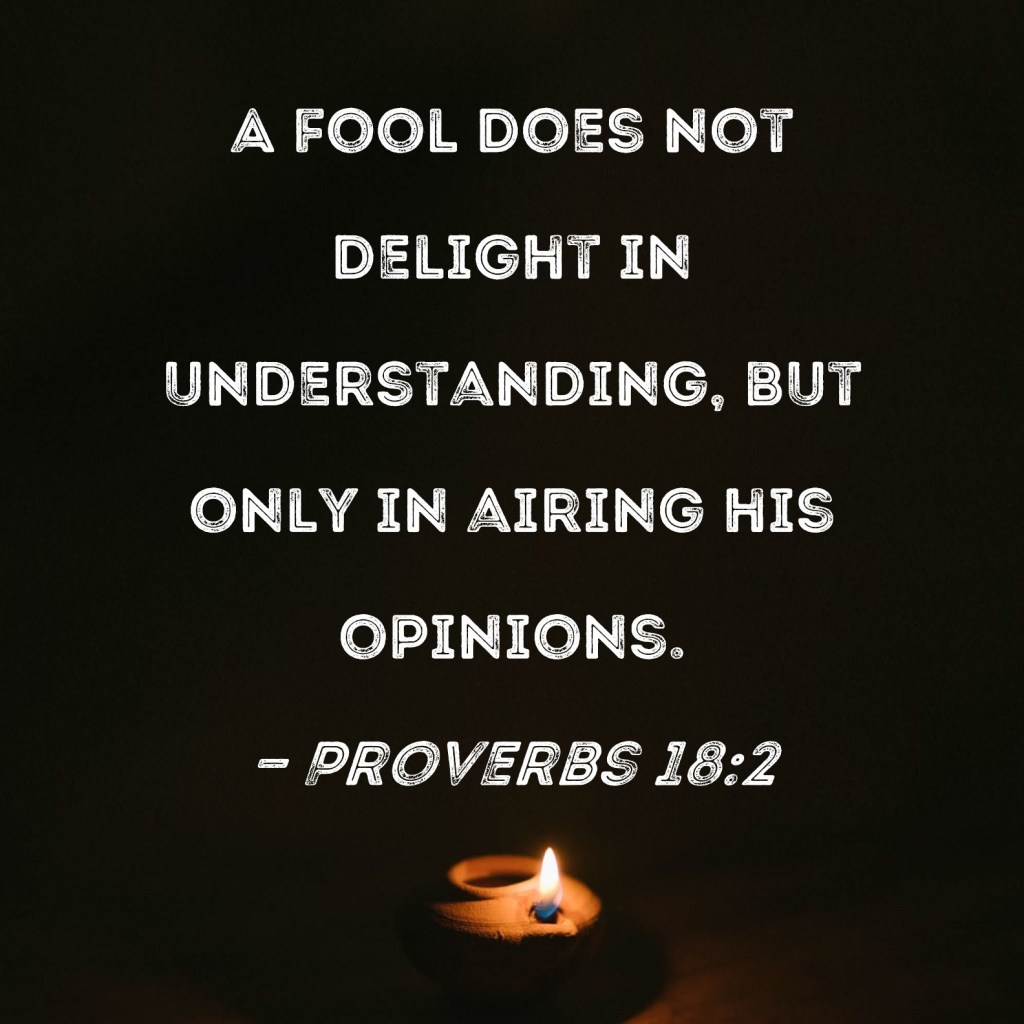
Proverbs 18: 2 Fools have no interest in understanding; they only want to air their own opinions.
Culturally, Spiritually, Politically…
This may mean…
That he takes no pleasure in the wisdom of others, is self-opinionated;
“A man of no sense has no need of wisdom.”
To try to teach a fool is to cast pearls before swine, and to give that which is holy unto dogs.
His only delight is in revealing his heart, displaying his un-wisdom and his foolish thoughts,
He thinks that he is showing himself superior to others, and benefiting the world at large.
Barnes Notes on the Bible: Another form of egotism. In “understanding,” i. e., self-knowledge, the “fool” finds no pleasure; but self-assertion, talking about himself and his own opinions, is his highest joy. https://biblehub.com/commentaries/barnes/proverbs/18.htm
Romans 12:3-8 3 For by the grace given me I say to every one of you: Do not think of yourself more highly than you ought, but rather think of yourself with sober judgment, in accordance with the faith God has distributed to each of you. 4 For just as each of us has one body with many members, and these members do not all have the same function, 5 so in Christ we, though many, form one body, and each member belongs to all the others. 6 We have different gifts, according to the grace given to each of us. If your gift is prophesying, then prophesy in accordance with your a faith; 7 if it is serving, then serve; if it is teaching, then teach; 8 if it is to encourage, then give encouragement; if it is giving, then give generously; if it is to lead, b do it diligently; if it is to show mercy, do it cheerfully.
Whether you’re engaging with others face to face voice to voice or on social media platforms, you will recognize that there are those who think that they have the best opinions and want everyone else to know it. “They are thinking more highly of themselves than they ought. Our foolishness has proliferated because technology has given us more mediums to express ourselves.
The power of the Book of Proverbs is that it demonstrates to us that there are two paths in life, the path of folly and the path of wisdom. Solomon knew all too well that when God asked him what he wanted, he sought wisdom above all things.
We can see that repeatedly humility is what marks the path of wisdom because humility acknowledges what God says about us is true.
We are needy
We don’t know everything
We don’t have everything
We cannot possibly save our lives.
In Proverbs 18:2 it’s obvious that the fool is in opposition to humility. rather than seeking out understanding, “they only want to air their own opinions.”
Just in Proverbs chapter 18 you will find extensive advice on what not to say:
Proverbs 18:6 Fools’ words get them into constant quarrels; they are asking for a beating.
2 Timothy 2:23 Again I say, don’t get involved in foolish, ignorant arguments that only start fights.
Proverbs 18:7 The mouths of fools are their ruin; their lips get them into trouble.
Proverbs 18:8 Rumors/Gossip are dainty morsels that sink deep into one’s heart.
Fools are much more interested in being heard; they’re much more concerned with being heard than listening.
Epictetus was a Greek Stoic philosopher. He said, “We have two ears and one mouth so that we can listen twice as much as we speak.
James 3:9-10 With the tongue we praise our Lord and Father and with it we curse human beings, who have been made in God’s likeness. Out of the same mouth come praise and cursing. My brothers and sisters, this should not be.
I find it distasteful when someone comes under the guise of investigative journalism and publicly discusses private church matters and sensitive details which then solicit an emotional outcry, sow further discord and damage the body of Christ.
Quote from the site Truth and Fire, “Even as the information might be factual, it is often unconfirmed, one-sided and is mostly meant to be slanderous. The gossip feeds to others the “juicy” details of private matters, usually with the goal of smearing the name and reputation of the subjects of their tale. They might even disguise their evil deeds as being a service to the public or to the Church.
Proverbs 18:4 A person’s words can be life-giving water; words of true wisdom are as refreshing as a bubbling brook.
Proverbs 18:20 Words satisfy the soul as food satisfies the stomach; the right words on a person’s lips bring satisfaction.
Proverbs 18:20-21 You will have to live with the consequences of everything you say. What you say can preserve life or destroy it; so you must accept the consequences of your words.
Proverbs 18:17 Any story sounds true until someone sets the record straight.
The Bible also teaches the importance of listening to others as a means of fostering understanding and community. James 1:19 advises, “Everyone should be quick to listen, slow to speak, and slow to anger” . This counsel highlights the virtue of patience and the importance of prioritizing listening over speaking, which can prevent misunderstandings and conflicts.
In the book of Proverbs, listening is associated with wisdom and discernment. Proverbs 18:13 warns, “He who answers a matter before he hears it—this is folly and disgrace to him” . This proverb underscores the foolishness of forming judgments without fully understanding the situation, emphasizing the need for attentive listening.
James 3:17 But the wisdom from above is first of all pure. It is also peace loving, gentle at all times, and willing to yield to others. It is full of mercy and the fruit of good deeds. It shows no favoritism and is always sincere.
Mark 12:30 And you must love the Lord your God with all your heart, all your soul, all your mind, and all your strength.’
2 Corinthians 10:4-5 4 The weapons we use in our fight are not the world’s weapons but God’s powerful weapons, which we use to destroy strongholds. We destroy false arguments; 5 we pull down every proud obstacle that is raised against the knowledge of God; we take every thought captive and make it obey Christ.
Matthew 12:34b For the mouth speaks what the heart is full of. Our heart is the seat of our intellect, will, and emotions.
My dichotomy of mercy and justice… Think about your words today. consider your use of social media and how you interact with people face to face. Do you seek understanding in those conversations, or are you more interested in making sure others know what you think?
Psalm 51:10-11 Create in me a clean heart, O God. Renew a loyal spirit within me. 11Do not banish me from your presence, and don’t take your Holy Spirit from me.
I love songs of the heart for the heart. Change My Heart O God written by Eddie Espinosa
“The year was 1982. I had been a Christian since 1969, but I saw a lot of things in my life that needed to be discarded. I had slowly become very complacent. I acknowledged my complacency, and I prayed to the Lord, ‘The only way that I can follow you is for you to change my appetite, the things that draw me away. You must change my heart!'” And then he penned these words…
Change my heart, O God, Make it ever true; Change my heart, O God, May I be like you. You are the Potter, I am the clay; Mold me and make me, This is what I pray.
In November of 2018, the Lord spoke to my heart through His Word in Colossians 3:2:
“Set your mind (affections) on things above, not on things on the earth.” NKJV”
Think about the things of heaven, not the things of earth.” NLT
There are so many distractions vying for our attention. Certainly, each of us has responsibilities that we must attend to – family, bills, jobs and the like. But what about all of the information bombarding us throughout the day. Perhaps it’s the news or social media. How do we control what enters our lives on a daily basis. I understand that some things are unavoidable, but what about those things that are?
I had to make a very conscientious decision to turn off specific notifications on my phone that would simply interrupt my day or steal my peace. Anytime a news flash would pop up it was more than likely negative. Neighborhood alerts are the worst where in many cases there was a picture or video included depicting a criminal act. I found that my fear and anxiety were being triggered simply by allowing these varied notifications to appear on my phone. Now I am not advocating for the lifestyle of a hermit, but I am offering that we “set our affections on things above” and not allow unnecessary distractions to pull us into a frenzy vortex.
I remember growing up as a child in the 60s, 70s, and 80s and life just seemed much simpler. Of course the internet hadn’t yet made its way into our culture. “Messaging” looked like a handwritten letter in the mailbox, someone knocking at your front door to sell you encyclopedias, a phone call on the house phone…yes…the one with that long cord that could wrap itself around the entire kitchen and laundry room too! Perhaps it was an invitation for a meal and conversation, or maybe a visit from a neighbor. There wasn’t a barrage of e-communication overwhelming our thoughts and vying for our time. Think about how many times a day you check your email, social media accounts, and text messages. How interesting that our phones can now provide us with a weekly report stating our average screen time. Even our phone providers know the obsession. Here is an interesting article in the Chicago Tribune that provides some insight into the dangers: https://www.chicagotribune.com/lifestyles/sc-fam-screen-time-alerts-1204-story.html
Our phones have gone beyond just being a communication tool, but have also become our wallets, recreation, reading portal, music, and well, you just name it. I am often reminded of these Scriptures:
John 15:4 Abide in Me, and I in you. As the branch cannot bear fruit of itself, unless it abides in the vine, neither can you, unless you abide in Me.
James 4: 7Therefore submit to God. Resist the devil and he will flee from you. 8Draw near to God and He will draw near to you. Cleanse your hands, you sinners; and purify your hearts, youdouble-minded. 9Lament and mourn and weep! Let your laughter be turned to mourning and your joy to gloom. 10Humble yourselves in the sight of the Lord, and He will lift you up.
The world cannot solve our problems nor provide us the peace for which we long. As we abide in Him, draw near to Him, the things of earth become dim and we begin to flourish. Spend more time seeking Him. Make an intentional effort to remove distractions. Find an accountability partner. You’ll won’t regret it!
My inspiration from for this exhortation comes from the Holy Spirit highlighting my reading of Today in the Word – Moody Publication and www.biblekeeper.com/but-god/
It reflects on the story of Joseph in the Bible.
Genesis 41:1–16, Genesis 45:1–15, Genesis 50
Joseph’s family was so dysfunctional that his brothers sold him into slavery!
Estrangement—Family members who avoid other family members.
Anger—It may be expressed or repressed.
Lack of Trust—Seen in faulty patterns of communication.
Deception—Inability to speak the truth to other family members.
Unhealthy Secrecy—Refusal to face the truth.
It’s not surprising that when we turn to the pages of Holy Scripture, we don’t have to look very far to find dysfunctional family relationships:
Consider the very first family—Adam and Eve who blamed each other for their own disobedience.
Consider their children—Cain murdered his brother Abel.
Consider Noah’s three sons—Ham disgraced his father by uncovering his nakedness.
Consider Abraham and Sarah—He lied about his wife, calling her his sister. His nephew Lot turned out to be a major disappointment.
Consider David—Although he was a great king, a great warrior, and a great poet, as a father and husband he was a failure. His marriage to Michal was largely a failure, his marriage to Bathsheba was based on an adulterous affair, and his son Absalom turned against him. As his kingdom crumbled, so did his family.
Joseph was a dreamer!
He was unjustly arrested, charged, and neglected.
Joseph was forgotten in a prison.
His hope of quick deliverance by the cupbearer’s report vanished (Gen. 40:23).
He eventually is brought before Pharaoh to interpret his dream.
His biggest challenge would be facing the ones who had betrayed him the most, his dysfunctional family.
In Genesis 41:1–16 we see:
The cupbearer eventually remembered Joseph after Pharaoh’s dream could not be explained (vv. 1–13).
They quickly retrieve Joseph from the dark, damp dungeon and clean him up.
They shave his scraggly beard, give him a bath, and clean clothes (v. 14).
They take him to Pharaoh and tell him to interpret a Pharaoh’s dream (v. 15).
Joseph’s response is “I cannot do it” (v. 16).
In that moment, we can’t imagine the reaction in the room, especially the cupbearer who recommended Joseph to the Pharaoh.
And then Joseph says in Genesis 41:16 “It is beyond my power to do this,” Joseph replied. “But God can tell you what it means and set you at ease.”
He interprets the dream with God’s help.
Genesis 41: 37-44
37 Joseph’s suggestions were well received by Pharaoh and his officials. 38 So Pharaoh asked his officials, “Can we find anyone else like this man so obviously filled with the spirit of God?” 39 Then Pharaoh said to Joseph, “Since God has revealed the meaning of the dreams to you, clearly no one else is as intelligent or wise as you are. 40 You will be in charge of my court, and all my people will take orders from you. Only I, sitting on my throne, will have a rank higher than yours.” 41 Pharaoh said to Joseph, “I hereby put you in charge of the entire land of Egypt.” 42 Then Pharaoh removed his signet ring from his hand and placed it on Joseph’s finger. He dressed him in fine linen clothing and hung a gold chain around his neck. 43 Then he had Joseph ride in the chariot reserved for his second-in-command. And wherever Joseph went, the command was shouted, “Kneel down!” So Pharaoh put Joseph in charge of all Egypt. 44 And Pharaoh said to him, “I am Pharaoh, but no one will lift a hand or foot in the entire land of Egypt without your approval.” 45 Then Pharaoh gave Joseph a new Egyptian name, Zaphenath-paneah. He also gave him a wife, whose name was Asenath. She was the daughter of Potiphera, the priest of On. So Joseph took charge of the entire land of Egypt.
Even though Joseph did not deserve what had been done to him, he continued to remain faithful to God.
He finds favor with Pharaoh, is promoted to second in command and given a wife!
He is given an Egyptian name- Zaphenath-paneah which several scholars agree means “the god speaks and he lives”
Genesis 42:1–8, Genesis 45:1–15
Since there was a famine in the land, Joseph’s brothers traveled to Egypt to buy grain (Gen. 42:1–8).
When they arrived, they did not recognize Joseph; they thought he was dead.
After the brothers journeyed back and forth a few times, Joseph revealed his identity: “I am your brother Joseph, the one you sold into Egypt!” (45:4). They were terrified (v. 3). The brother who they had tormented now held all the power.
Joseph could have been angry, scathed, tainted by the betrayals and trials he experienced But God… He had the God-given ability to forgive, and love.
Genesis 45: 4-7 Then Joseph said to his brothers, “Come close to me.” When they had done so, he said, “I am your brother Joseph, the one you sold into Egypt! 5 And now, do not be distressed and do not be angry with yourselves for selling me here, because it was to save lives that God sent me ahead of you. 6 For two years now there has been famine in the land, and for the next five years there will be no plowing and reaping. 7 But God sent me ahead of you to preserve for you a remnant on earth and to save your lives by a great deliverance.
Years later, after Jacob’s death, Joseph’s father, the brothers become fearful, because they think that now that Jacob is dead that Joseph is going to exact vengeance on them – pay them back for what they did to him. They still didn’t get it!!!
So they send a message to Joseph…
Genesis 50:16-18
16 So they sent this message to Joseph: “Before your father died, he instructed us 17 to say to you: ‘Please forgive your brothers for the great wrong they did to you—for their sin in treating you so cruelly.’ So we, the servants of the God of your father, beg you to forgive our sin.” When Joseph received the message, he broke down and wept. 18 Then his brothers came and threw themselves down before Joseph. “Look, we are your slaves!” they said. 19 But Joseph replied, “Don’t be afraid of me. Am I God, that I can punish you? 21 No, don’t be afraid. I will continue to take care of you and your children.” So he reassured them by speaking kindly to them.
Joseph somehow continued to trust God. He realized that what others had meant for evil, God intended for good (Gen. 50:20).
He forgave those who hurt him the most and reunited with his family (vv. 5–7). He knew God had a purpose: “It was not you who sent me here, but God” (v. 8). Because of his position, Joseph was able to provide for his family in their time of need. His brothers were given a second chance because Joseph saw things from God’s perspective (vv. 9–15).
Holy Spirit, help us to see things from God’s perspective!
But God…
I’m unworthy…
Paul, the Apostle – Galatians 1:15-16 15But God in his grace chose me even before I was born, and called me to serve him. And when he decided 16 to reveal his Son to me, so that I might preach the Good News about him to the Gentiles, I did not go to anyone for advice
I feel helpless…
Romans 5:6-86 When we were utterly helpless, Christ came at just the right time and died for us sinners. 7 Now, most people would not be willing to die for an upright person, though someone might perhaps be willing to die for a person who is especially good. 8But God showed his great love for us by sending Christ to die for us while we were still sinners.
I feel unloved…
Ephesians 2: 3 All of us used to live that way, following the passionate desires and inclinations of our sinful nature. By our very nature we were subject to God’s anger, just like everyone else. 4 But God is so rich in mercy, and he loved us so much, 5 that even though we were dead because of our sins, he gave us life when he raised Christ from the dead. (It is only by God’s grace that you have been saved!)
I feel weak…
Psalm 73:26 My health may fail, and my spirit may grow weak, but God remains the strength of my heart; He is mine forever.
I am tempted…
1 Corinthians 10:13 No temptation has overtaken you except such as is common to man; but God is faithful, who will not allow you to be tempted beyond what you are able . . .
I am unfruitful…
1 Corinthians 3: I planted, Apollos watered, but God gave the increase.
I’m facing death…
Acts 13:29-30 When they had carried out all that was written about him, they took him down from the cross and laid him in a tomb. But God raised him from the dead…
My situation is impossible
Matthew 19:26 Jesus looked at them and said, “With man this is impossible, but with God all things are possible.
I’m troubled
Acts 7:9-10 Because the patriarchs were jealous of Joseph, they sold him as a slave into Egypt. But God was with him and rescued him from all his troubles.
I’m fearful…
1 Samuel 23:14 David stayed in the desert strongholds and in the hills of the Desert of Ziph. Day after day Saul searched for him, but Goddid not give David into his hands.
I’m not smart enough…
1 Corinthians 1:26-31 Brothers and sisters, think of what you were when you were called. Not many of you were wise by human standards; not many were influential; not many were of noble birth. 27But God chose the foolish things of the world to shame the wise; God chose the weak things of the world to shame the strong. 28 God chose the lowly things of this world and the despised things—and the things that are not—to nullify the things that are, 29 so that no one may boast before him. 30 It is because of him that you are in Christ Jesus, who has become for us wisdom from God—that is, our righteousness, holiness and redemption. 31 Therefore, as it is written: “Let the one who boasts boast in the Lord.”
I need revelation…
1 Corinthians 2:10 Eye has not seen, nor ear heard . . . the things which God has prepared for those who love Him . . . But God has revealed them to us through His Spirit.
It is evident that “But God” is a powerful phrase found in the Bible and points us God’s faithfulness and power. We are limited and God is limitless. Nothing is impossible with our God.
“But God” Scriptures remind us that we can trust Him to take the ashes of our lives and make them beautiful!
The book of I Samuel begins in the day when the judges still ruled Israel. Samuel was the last judge and the first prophet and priest to serve during the time of a king.
Judge – someone who led the people in government and during times of war
Prophet – someone that God chooses to speak for Him and to tell of events in the divine plan
Priest – someone who fulfilled the religious duties required by God
Samuel is the best example of a good judge governing the people by God’s word and not following his own impulses.
Samuel was the man who anointed Saul as Israel’s first king.
What is the story surrounding Samuel’s birth?
Elkanah like many other of the Old Testament leaders was married to more than one wife. This was certainly not a part of God’s divine plan.
Polygamy was a common custom in those days when “every man did that which was right in the sight of his own eyes.”
Some say that because in these societies many died in battle, polygamy became an acceptable way of supporting women who would have otherwise remain unmarried.
Either way many times polygamy presented family problems as we will see here. Anytime something is not a part of God’s plan, it creates problems.
Read about Leah and Rachel. And also about Sarah and Hagar
Elkanah´s two wives are Peninnah and Hannah.
A significant difference between these two women is that Peninnah was able to bear children while Hannah could not.
This was difficult for Hannah since in the Middle Eastern culture she was considered a failure as a woman – it was seen as a social embarrassment. Children were a source of labor for the family and were required to take care of their parents in old age. If a woman wasn’t able to bear children she may be required to up one of her servant girls to her husband.
Now Elkanah could have left her (since a man could divorce a barren wife) but he remained lovingly devoted despite criticism and his rights under the law.
Now each year Elkanah and his family would travel up to Shiloh (abundance) to worship and sacrifice to the Lord.
This had to be a difficult time for Hannah seeing all of the families with their children and she with none. NO ABUNDANCE!
(I Samuel 1:3-5)
This man went up from his city yearly to worship and sacrifice to the LORD of hosts in Shiloh. Also the two sons of Eli, Hopni and Phinehas, the priests of the LORD, were there. And whenever the time came for Elkanah to make an offering, he would give portions to Peninnah his wife and to all her sons and daughters. But to Hannah he would give a double portion, for he loved Hannah, although the LORD had closed her womb.
How ironic that a double portion was given to a barren woman. Love compelled it!! Though she saw herself barren, God saw fertile land!
The favoritism demonstrated by Elkanah created dissention, competition, insecurity, and esteem issues.
Even though Hannah was unable to bear children Elkanah gave her the double portion, because he loved her very much although the Lord had shut up her womb.
Hannah had favor and she was humble. Prov 3:34 He mocks proud mockers but gives grace to the humble.
She was taunted by Peninnah not only because she was barren, but Penninah knew that Hannah was more favored by Elkanah.
The taunting took place even while they were on their way to Shiloh – a place where they were going to worship God!
PENNINAH BECAME THE VOICE OF CONDEMNATION IN HANNAH’S LIFE.
Peninnah appeared to have rejoiced in Hannah’s barrenness. Perhaps she felt this gave her a leg up, because she knew that Eli loved Hannah more.
Penninah could have ministered to Hannah. She could have advocated for her before the Lord, helped to bear her burden and bring it to the cross.
She could have prayed for healing, but she chose not to. There is such power when we pray for one another, agree with one another for breakthrough!
One puts a thousand to flight and 2 tens of thousands! Deuteronomy 32:30
For where two or three gather together as my followers, I am there among them. Matthew 18:20
The earnest prayer of a righteous person has great power and produces wonderful results! James 5:16
The blind man in Mark 8 was brought to Jesus by others!
A paralyzed man was lowered through the roof by others!
There is something beautiful about a saved, spirit-filled, nurturing sister in Christ!!! Unlike the cattiness of the secular culture!!!
Now Hannah knew how much her husband loved her but he could simply not comfort her. The jeers and mocking of Peninnah were louder.
We know how much God loves us, but sometimes still allow the voice of condemnation to drown out the voice of truth.
Do we listen to the voice of the enemy? Of our insecurity? Of our pain? Of our low self-esteem? Our doubt? Are they louder than the love of God who says that His love covers a multitude of sin or that His perfect love expels all fear?
“Why are you crying, Hannah?” Elkanah would ask. “Why aren’t you eating? Why be downhearted just because you have no children? You have me—isn’t that better than having ten sons?”
ELKANAH BECAME THE VOICE OF COMPROMISING COMFORT IN HANNAH’S LIFE.
He just couldn’t understand her longing to have children
Who is it that can truly comfort us? Can we find real comfort in a man, a job, children, ministry, money?
Do we give up and compromise with our barren situations?
Even with these voices of condemnation and compromise, Hannah showed no outward conflict, she did not retaliate. Though she was grieved in spirit, we do not hear any railing or furious revenge on her part.
Here is what may seem hard to swallow – The Lord had shut up her womb! The Lord kept her from having children! (Job)
How could this be? This seems cruel and unkind of God.
In the midst of all that was going though, God had a plan. It is our response to Him that determines the fulfillment of His plan and our destiny. Job said, “He knows where I am going and He controls my destiny.”
It is about God’s timing!
It is about God’s divine purpose!
It is about the revelation of Himself through us when we respond accordingly!
It is about building treasure in heaven rather pleasure on earth.
It is about the unconditional love of man towards God.
It is about our willingness to press through and not break down.
It is ultimately about the intimacy that is formed when falling upon Him when all has fallen upon us.
Hannah was the fourth great woman in sacred history who grieved because she could not conceive and among the 4 she was the most prayerful.
Sarah laughed when she learned that she would bare a son in her old age.
Rebekah bore her trial with listlessness and indifference.
Rachel irritated with her long wait for a child, exclaimed, “Give me children, or else I die.”
Hannah sought her call as a mother in the power of God, for she desired a son as a poet desires a song. On her knees in prayer!
What did Hannah do?
Hannah was reduced to the place of tears and a loss of appetite.
She must have thought, how many times have I come to Shiloh, this place called “abundance” and have left with the same bitterness of soul?
Where is my God that I have not found favor with Him? What is my sin that He has not heard my prayer?
But Hannah CONTINUED to go to Shiloh. She pressed through, she didn’t get weary in the well-doing,
Hannah’s Prayer for a Son
9 Once after a sacrificial meal at Shiloh, Hannah got up and went to pray. Eli the priest was sitting at his customary place beside the entrance of the Tabernacle.10 Hannah was in deep anguish, crying bitterly as she prayed to the Lord. 11 And she made this vow: “O Lord of Heaven’s Armies, if you will look upon my sorrow and answer my prayer and give me a son, then I will give him back to you. He will be yours for his entire lifetime, and as a sign that he has been dedicated to the Lord, his hair will never be cut.” 12 As she was praying to the Lord, Eli watched her. 13 Seeing her lips moving but hearing no sound, he thought she had been drinking. 14 “Must you come here drunk?” he demanded. “Throw away your wine!” 15 “Oh no, sir!” she replied. “I haven’t been drinking wine or anything stronger. But I am very discouraged, and I was pouring out my heart to the Lord. 16 Don’t think I am a wicked woman! For I have been praying out of great anguish and sorrow.” 17 “In that case,” Eli said, “go in peace! May the God of Israel grant the request you have asked of him.” 18 “Oh, thank you, sir!” she exclaimed. Then she went back and began to eat again, and she was no longer sad.
ELI BECAME THE VOICE OF CRITICISM IN HANNAH’S LIFE.
HANNAH OVERCAME ALL OF THESE VOICES, CONDEMNATION, COMPROMISE AND CRITICISM, BY USING HER VOICE TO CRY OUT TO GOD! HER INTERCESSION EXUDED SUCH INTENSITY THAT SHE APPEARED INTOXICATED.
All the years of faithfulness and praying allowed God to purify her prayers! She came to the place that if God blessed her with a child, the very thing that she had prayed for and that was most precious to her, she would be willing to surrender back to the Lord.
Hannah came to the place of purified prayer. It was no longer about her dignity, her place in society, her own desires, but she prayed in bitterness of soul, weeping in anguish pouring her heart out to the Lord.
Prayer comes in various intensities. Jesus prayers were also a prime example of purified prayers since He was sinless.
Jesus fasted and prayed before confronting the enemy.
In John 11 He groaned in His spirit and offered prayers to the Father before calling Lazarus forth.
Before every miracle Jesus lifted His eyes to heaven to the Father.
In Luke 22:44, in the garden Jesus prayed with such intensity that He sweat great drops of blood.
In Hebrews 5:7-8 During the days of Jesus’ life on earth, he offered up prayers and petitions with loud cries and tears to the one who could save him from death, and he was heard because of his reverent submission.
I Samuel 1:10-11 “O LORD of hosts, if You will indeed look on the affliction of Your maidservant and remember me, and not forget Your maidservant, but will give Your maidservant a male child, then I will give him to the LORD all the days of his life, and no razor shall come upon his head.”
Eli the priest blessed her prayer and she rejoiced because she believed that the Lord heard.
Three times she uses the word “maidservant” demonstrating her humility towards God.
Her prayer is to give the Lord back whatever it is that He gives her, withholding nothing from Him.
This is pure, humble prayer that bears fruit. Only the Lord knows the hearts of men. Jer 17:10 I the LORD search the heart, I try the reins, even to give every man according to his ways, and according to the fruit of his doings.
One does not engage in prayer to the Lord simply for the results but for the relationship with Him! All fruit is born through cultivating our relationship with Him.
The ending of the story is that in due time (God’s time) she gives birth to Samuel who becomes a minister of the Lord. Priest, Prophet, and Judge. We also understand that she gave birth to 5 more children!
She never turns back on her promise.
24 Now when she had weaned him, she took him up with her, with three bulls, one ephah of flour, and a skin of wine, and brought him to the house of the LORD in Shiloh. And the child was young. 25 Then they slaughtered a bull, and brought the child to Eli. 26 And she said, “O my lord! As your soul lives, my lord, I am the woman who stood by you here, praying to the LORD. 27 “For this child I prayed, and the LORD has granted me my petition which I asked of Him. 28 “Therefore I also have lent him to the LORD; as long as he lives he shall be lent to the LORD.” So they worshiped the LORD there. She offers sacrifices, she testifies, and gives back to God what she vowed to give Him!
Are there areas of your life that are barren? Times when nothing “comes to birth” – barrenness with our jobs, our relationships, even ministry?
What is in our hearts when we pray?
Ought towards another?
Selfish ambition?
Jealousy?
Competitiveness?
Some hidden sin?
I prayed 5 years for my husband’s salvation! I was driven by God’s intense love for him, not by any personal benefit.
She then prayed and praised…some say that her triumphant prayer has been called the forerunner of Mary’s Magnificat.
This prayer exhibits the fervency, depth, and fire of a woman who is truly rejoicing.
2:1 And Hannah prayed and said: “My heart rejoices in the LORD; My horn is exalted in the LORD. I smile at my enemies, Because I rejoice in Your salvation. 2 “No one is holy like the LORD, For there is none besides You, Nor is there any rock like our God. 3 “Talk no more so very proudly; Let no arrogance come from your mouth, For the LORD is the God of knowledge; And by Him actions are weighed. 4 “The bows of the mighty men are broken, And those who stumbled are girded with strength. 5 Those who were full have hired themselves out for bread, And the hungry have ceased to hunger. Even the barren has borne seven, And she who has many children has become feeble. 6 “The LORD kills and makes alive; He brings down to the grave and brings up. 7 The LORD makes poor and makes rich; He brings low and lifts up. 8 He raises the poor from the dust And lifts the beggar from the ash heap, To set them among princes And make them inherit the throne of glory. “For the pillars of the earth are the Lord’s, And He has set the world upon them. 9 He will guard the feet of His saints, But the wicked shall be silent in darkness. “For by strength no man shall prevail. 10 The adversaries of the LORD shall be broken in pieces; From heaven He will thunder against them. The LORD will judge the ends of the earth. “He will give strength to His king, And exalt the horn of His anointed.”